South Korea · Where to stay
Where to Stay in Busan: Station, Seomyeon, Haeundae or Gwangalli
Choose a Busan base for early trains, markets, mixed sightseeing or beach evenings, with hotel-location checks for slopes, station exits, noise and luggage.
Our founder previously worked for a travel company. About Destinode
On this page
Busan has several useful centers, and none is beside every major attraction. A hotel that is excellent for a beach morning can be inconvenient for an early KTX departure. A station hotel can simplify luggage handling while leaving you with a substantial journey to the eastern coast.
This guide recommends areas by travel pattern rather than ranking hotels we have not stayed in. Room prices and availability have not been surveyed. Use the area comparison to narrow your search, then check the specific building, room type and walking route before booking.
Choose the area from three real journeys
| Area | Strongest reason to choose it | Tradeoff to accept |
|---|---|---|
| Busan Station | Arrival, departure and a short stay built around rail | Beach time requires a separate journey |
| Nampo and Jagalchi | Markets and the older port-side districts | Eastern attractions are not on the doorstep |
| Seomyeon | A mixed itinerary with evenings in an urban neighborhood | You are choosing connections over a sea view |
| Haeundae | Beach mornings and eastern coastal attractions | Allow more room for station and western-city journeys |
| Gwangalli | Dinner and a walk beside the bridge-facing beach | The beachfront property and the station may be separate walks |
Test the route from arrival point to hotel, from hotel to your most important daytime activity, and from your likely dinner area back to the room. Repeat the exercise for departure day with luggage. Those four journeys usually reveal more than a search platform's distance from the center.
Do not assume that the closest-looking rail line provides the simplest trip. Check the actual station, interchange and exit using the operator's route information and a current journey planner. Save the hotel's Korean address so that it remains identifiable even when English spellings differ. [1]
Busan Station: make the short stay easy
Choose this area when a train arrival and early onward departure shape the visit. Being able to drop bags promptly and retrieve them before boarding can be more valuable than an impressive lobby. It also reduces the temptation to carry a large suitcase through a sightseeing day.
Check which side of the station the hotel is on and the walking route from the exit you will use. A small straight-line distance can hide road crossings, ramps or stairs. Ask the property for a practical luggage route rather than assuming the station name in the hotel listing guarantees easy access.
The compromise is that a beach visit remains an excursion. If you intend to spend every evening at Haeundae, the station location may save two luggage journeys while adding several leisure journeys. Calculate that tradeoff across the entire stay, not only on arrival day.
Nampo: markets and the old port on your doorstep
Nampo is a useful starting point for travelers drawn to the market districts. KTO groups Jagalchi, Gukje and Bupyeong Kkangtong with a Gamcheon visit in its Busan route guidance. Staying nearby lets you give those areas more time without treating dinner as another cross-city transfer. [2]
Distinguish a room near a major road from one inside a dense shopping or market lane. Ask whether a taxi can reach the entrance, when reception is staffed and how late luggage can be collected. These details matter for a small property just as much as the room's appearance.
A good Nampo stay is not a promise of silence. Check recent room-specific comments for street or neighboring-business noise and ask about rooms away from the busiest frontage if you are sensitive to it. Do not assume a high floor alone resolves every noise source.
Seomyeon: a practical choice for a mixed itinerary
Seomyeon makes sense when you want to divide the stay between the older city, the eastern coast and urban shopping or café time. Visit Busan highlights Seomyeon's walking areas and nearby Jeonpo, which can make the neighborhood itself part of the holiday rather than merely somewhere to sleep. [3]
Choose a hotel near the station access that serves your plans, not just anywhere within a large Seomyeon search radius. A convenient entrance and an uncomplicated walk can be more useful than a slightly lower rate several busy blocks away. Check lifts if your group cannot comfortably carry bags on stairs.
Seomyeon is a compromise base, not a guarantee that every attraction is close. You will still travel to beaches and hillside sights. Its appeal is the ability to organize separate local days while returning to a neighborhood with your preferred evening food and amenities.
Haeundae: stay for the beach, not only one attraction
Haeundae is the strongest candidate when you want the coast to be part of ordinary mornings and evenings. It also suits a day focused on the Blueline Park corridor, whose coastal attractions run from Mipo toward Cheongsapo and Songjeong. Check the actual starting station of your ticket when choosing the day's route. [4]
Compare beach distance, station access and the exact room view separately. A hotel near the beach may offer rooms facing another building; a sea-view room may have a partial rather than full view. Read the room category you are buying, not only the property's gallery.
For families, verify bed sizes, occupancy rules and whether breakfast covers every guest. For a couple planning quiet evenings, compare a room farther from the busiest frontage with the convenience of being directly on it. These are individual property checks; the neighborhood name does not settle them.
Gwangalli: choose it for the evening you want
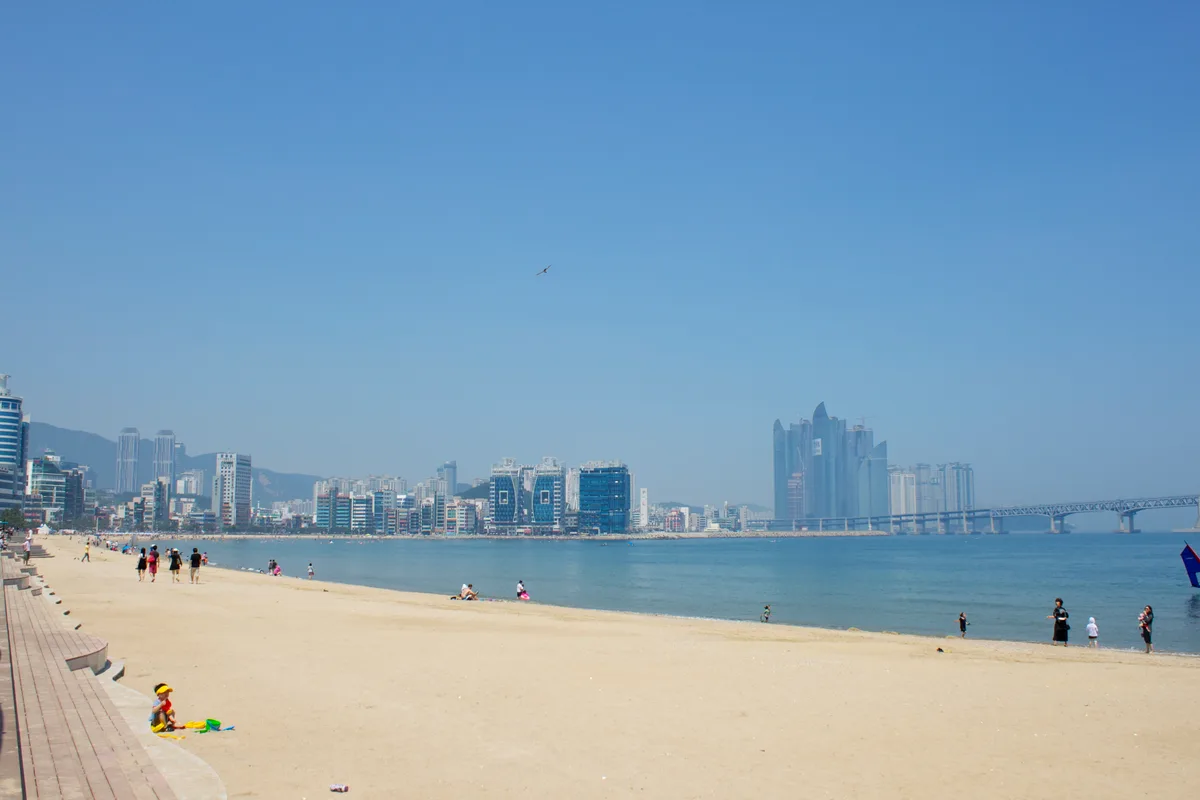
Gwangalli's defining attraction is the waterfront facing Gwangandaegyo Bridge. The tourism board describes it as a beach area with an illuminated seafront after dark. Choose it because dinner and a walk there sound appealing, rather than relying on a particular performance or event happening during your stay. [5]
Check the walk between the station and the property. A beachfront stay can mean carrying luggage farther than a hotel directly beside a rail entrance. That may be a worthwhile trade for several evenings by the sea, especially if you budget a straightforward arrival transfer.
Ask whether the room's advertised bridge view is visible from the room itself, a shared terrace or only the rooftop. Keep cancellation terms in mind if the view is the main reason for paying more. Weather can affect the experience even when the room category is delivered correctly.
Check the room and the route before paying
- Map the exact entrance and the nearest useful station exit, including slopes and road crossings.
- Confirm the sleeping arrangement and final guest count; a photograph of two beds is not the same as a booked twin-room category.
- Compare total stay prices with matching breakfast and cancellation conditions.
- Ask about late check-in, bag storage and the time you can collect luggage on departure day.
- Check noise, lift access and any entrance steps that matter to your group.
- Save the address and arrival instructions somewhere accessible without mobile data.
For two or three nights, one well-chosen base is usually simpler than splitting station and beach hotels. For a longer visit with distinct plans, a split can work: complete the western sights before moving east, rather than crossing back repeatedly after the move.
If your route continues to Gyeongju, consider whether that overnight belongs after Busan rather than as a return excursion. Accommodation planning improves when each stay advances the wider journey instead of functioning as a separate booking decision.
BEFORE YOU GO
Common questions
What is the best area for a first visit?
Seomyeon is a useful starting comparison for mixed sightseeing, but Haeundae is better when beach time dominates and Busan Station can be more practical for a very short rail-based stay. Choose from your actual route.
Is Nampo the same as Busan Station?
No. Treat them as separate accommodation choices and check the actual hotel address. Nampo emphasizes the old-port market districts; a station stay prioritizes rail arrival and departure.
Should I pay extra for a sea view?
Only if you expect to spend enough time in the room to enjoy it. Check the exact view category and compare it with a cheaper room plus more time on the public waterfront.
THE INFORMATION BEHIND THE GUIDE
References
Official and operator information checked on 9 October 2026. Recheck conditions for your own dates. The itinerary and decision examples are editorial suggestions; they are not booked services or first-hand reviews.
- Busan Metro route and station information ↗Busan Transportation Corporation · checked 9 October 2026
- Busan markets and Gamcheon route ↗Korea Tourism Organization · checked 9 October 2026
- Seomyeon, Jeonpo and Busan neighborhood walks ↗Busan Tourism Organization · checked 9 October 2026
- Haeundae Beach Train and Sky Capsule routes ↗Haeundae Blueline Park · checked 9 October 2026
- Gwangalli Beach and Gwangandaegyo Bridge ↗Busan Tourism Organization · checked 9 October 2026