South Korea · Things to do
Seoraksan From Seoul: Day Tour, Independent Trip or Overnight Stay
Choose a Seoraksan day tour, an independent trip through Sokcho or an overnight stay. Check trail access, cable-car limits and the return journey before hiking.
Our founder previously worked for a travel company. About Destinode
On this page
Seoraksan is a mountain trip with transport attached, not an attraction that fits automatically into any spare Seoul day. A successful plan starts with the walk you can comfortably complete and the latest safe return time, then works backwards to the city departure.
This guide concerns the outer Seorak approach at Sogongwon, commonly reached through Sokcho. Tourism and cable-car information was checked on 18 October 2026. We could not verify the park's live trail-closure board or date-specific bus departures. The route comparisons below are planning options, not confirmation that a trail or service will run on your date.
Choose the format before choosing a summit
| Format | Best fit | Main constraint |
|---|---|---|
| Organized Seoul day trip | A first visit with simpler transport | Fixed time in the park and a shared departure |
| Independent same-day trip | A modest walk with confirmed connections | Two intercity journeys plus local transport |
| One or more nights around Sokcho | A hiking priority or a slower visit | Accommodation and another luggage move |
A tour can remove the work of buying separate transport, but it cannot remove congestion, weather or a cable-car queue. Read the actual time allowed inside the park. A package combining several distant attractions may offer much less walking time than a Seoraksan-only day. Choose a short route that fits the confirmed stop rather than treating the excursion's total duration as hiking time.
For a concrete comparison, Klook lists TOURSTORY KOREA’s Seoraksan and Naksansa excursion with 3.5 hours of self-guided park time. The cable car, meals and personal travel insurance are excluded. That is a sightseeing stop to compare with your chosen short walk, not a guided Ulsanbawi ascent. We have not verified a selected departure’s availability. [1]
An overnight stay is our preferred planning option when Ulsanbawi is the main purpose. It separates the long journey from the hike and creates room to respond to conditions. It still does not guarantee that a closed path will reopen during your stay.
Separate valley walking from Ulsanbawi
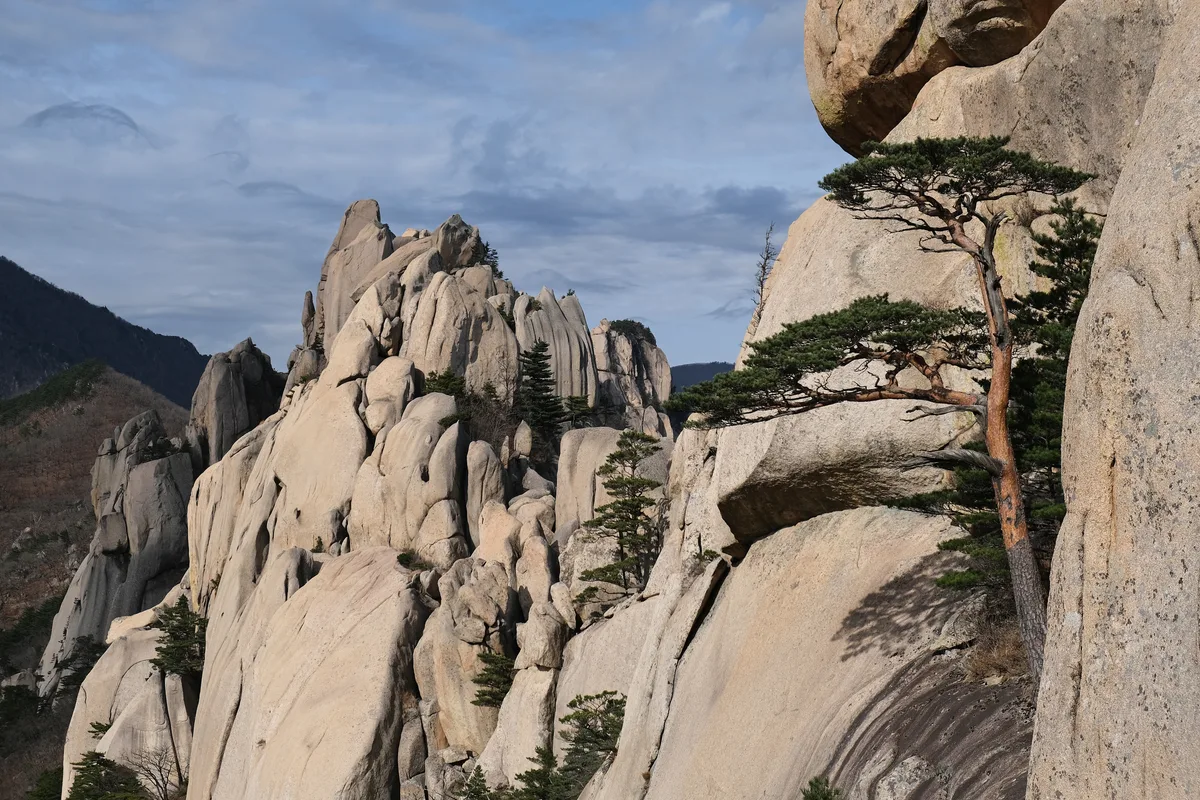
Korea Tourism Organization's national-park guide describes an Ulsanbawi circuit from Sogongwon through Sinheungsa and Heundeulbawi, with a published estimate of 7.6 km and four hours return. Its separate Ulsanbawi listing describes roughly three hours to the top from Sogongwon. These differing estimates are a warning against treating one headline duration as a personal promise. [2] [3]
Choose the route for the slowest member of the party and add time for navigation, rests, photographs and any queue on narrow sections. The climb beyond Heundeulbawi is substantially different from a gentle walk near the entrance. A cable-car outing, a valley visit and an Ulsanbawi hike should be treated as separate choices until you have enough confirmed time for more than one.
Set a turnaround time before starting. Calculate it from daylight, the route's current entry restrictions and your booked return, taking the earliest constraint. Reaching the summit is optional; returning before the transport and daylight margins disappear is part of the plan. If the group is slower than expected, turn around earlier rather than spending the buffer.
Understand what the cable car includes
The operator describes a roughly five-minute ride towards Gwongeumseong. It is a round-trip service, and it does not provide a hiking path for walking between the lower and upper stations. This is a different destination from Ulsanbawi. Weather can interrupt operation, so an upper-station ride should remain conditional until the operator confirms the day's service. [5]
The visitor guide states that tickets are sold on site for the same day, without advance reservations. It lists the adult return fare, for middle-school age and above, at KRW 16,000 when checked. This published fare is not a reserved departure or a promise of a short wait. If a tour advertises cable-car access, ask whether the fare is included and what happens when tickets or operation are unavailable. [4]
Do not assume that buying the ride removes every step or uneven surface beyond the station. Ask the operator about your exact mobility needs and the route available at the top. A non-hiking companion may prefer a shorter park visit rather than waiting alone while others attempt a lengthy climb.
Build the independent journey through Sokcho
The tourism guide identifies local buses 7 and 7-1 between Sokcho's intercity terminal area and Sogongwon. Use that as route orientation, then check the current stop, direction and timetable locally. We have not verified a travel-date bus fare, first departure or last departure. Seoul terminal names and Sokcho arrival terminals matter; do not substitute one terminal for another because both bookings say Sokcho. [2]
- Confirm the Seoul departure terminal and the exact Sokcho arrival terminal.
- Check how to reach Sogongwon from that terminal, including the return stop.
- Reserve or otherwise verify the intercity journey back before beginning the hike.
- Allow for local-bus waiting, queues and traffic as separate parts of the day.
- Keep the return booking and hotel address accessible without a data connection.
The useful calculation is door-to-door: hotel to terminal, boarding margin, intercity journey, local transfer, park time and all return stages. We do not publish a fixed total because the departures and traffic have not been verified for your date. If the remaining park time looks tight, shorten the walk or add an overnight stay.
Check closures, weather and daylight together
Mountain access is controlled independently of a tourism listing. Fire-prevention periods, weather restrictions and individual trail notices can change which paths are available. Historical seasonal closure dates are not a confirmed 2026 notice. Check Korea National Park Service's Seoraksan notices and obtain a current answer from the park or your operator before paying for a hike-dependent plan.
Use the Korea Meteorological Administration for current forecasts and warnings, choosing the mountain area rather than assuming Seoul's forecast applies. Check the local sunset time for your actual date as well. We have not verified the weather or sunset for an individual future visit, and a clear city morning does not establish conditions on an exposed ridge. [6]
- Carry suitable footwear, water, food and an extra layer for the route you choose.
- Use offline maps as an aid, while following official signs and closures.
- Keep enough phone battery for the return journey and emergency communication.
- Abandon the high route when weather, access or the group's condition makes it unsuitable.
Choose an overnight base and a fallback
Compare a Sokcho town base with accommodation closer to the park by the first morning's transport and the evening you want. A town stay can suit dinner and a coast-focused second day; a park-side stay may simplify reaching the entrance. Check the property's actual position, meal options, luggage storage and the transport available at your intended hour. Neither address automatically includes a shuttle.
A useful two-day outline is to travel from Seoul, settle in and keep the first afternoon flexible, then make the park visit on the next suitable day before a generously timed return. If the forecast is uncertain, avoid filling the remaining day with non-refundable commitments. This is an editorial sequence, not a confirmed timetable.
If mountain access is unsuitable, a Sokcho town or coastal day can replace the hike, provided local conditions allow it. A different excursion such as Nami Island is a separate Seoul plan rather than a nearby substitute you can simply insert after arriving at Seoraksan. Decide the alternative before departure if you want to avoid travelling for an activity you cannot do.
Read the tour's cancellation and walking terms
Ask a prospective operator for its meeting point, actual park time, guide language, walking route, included admissions and the missed-departure policy. Distinguish transport with free time from an escorted mountain hike. A general tour guide is not proof that the package includes supervision on the route you intend to climb.
BEFORE YOU GO
Common questions
Can I hike Ulsanbawi on a Seoul day tour?
Only consider it if the operator confirms enough park time, the route is open and the hike fits your ability. Many sightseeing stops are too short. Do not infer permission or sufficient time from a Seoraksan destination label.
Can I reserve the Seorak cable car in advance?
The operator's guide states same-day on-site ticket sales without advance reservations. A package listing does not itself prove a reserved cable-car slot; ask how the operator handles queues and suspension. [4]
Is Seoraksan open today?
We could not verify the live trail-closure board on our research date. Check the park's current notice and the specific route, then check the cable-car operator separately. An open park entrance does not mean every trail is accessible.
THE INFORMATION BEHIND THE GUIDE
References
Official and operator information checked on 18 October 2026. Recheck conditions for your own dates. The itinerary and decision examples are editorial suggestions; they are not booked services or first-hand reviews.
- Seoraksan and Naksansa full-day tour ↗Klook / TOURSTORY KOREA · checked 18 October 2026
- National parks and the Ulsanbawi route ↗Korea Tourism Organization · checked 18 October 2026
- Ulsanbawi Rock ↗Korea Tourism Organization · checked 18 October 2026
- Seorak Cable Car visitor guide ↗Seorak Cable Car · checked 18 October 2026
- Seorak Cable Car route and notices ↗Seorak Cable Car · checked 18 October 2026
- Weather forecasts and warnings ↗Korea Meteorological Administration · checked 18 October 2026