South Korea · Getting around
Incheon vs Gimpo: Which Seoul Airport Fits Your Trip?
Compare Incheon (ICN) and Gimpo (GMP) for Seoul stays, Jeju connections and airport transfers. Choose by your flight, hotel and complete journey.
Our founder previously worked for a travel company. About Destinode
On this page
The cheapest ticket labeled Seoul may involve a different airport from the next flight. The important distinction is the three-letter code: ICN for Incheon and GMP for Gimpo. Treat these as different airports even when a booking search places both under the same city.
This guide compares travel decisions rather than promising a universal minimum connection time. Flight schedules, terminal assignments and airline check-in limits can change. Check the actual flights first, then calculate the ground journey to the hotel or next airport.
Compare the complete journey before buying the flight
| Your situation | Start by comparing | Deciding factor |
|---|---|---|
| Staying only in Seoul | Both airports if your route offers both | Arrival time, hotel connection and total ticket cost |
| Flying onward to Jeju | The airports on both tickets | Whether you must change airports and recheck baggage |
| Arriving late at night | Available ground transport at the actual arrival time | The journey after baggage collection, not scheduled touchdown |
| Continuing to Busan by train | The full airport–station–rail journey | A realistic margin before the train, with luggage |
| Returning from another Korean city | Direct international departure versus returning to Seoul | The extra domestic journey and connection exposure |
A more expensive flight can be better value if it removes an airport change, an overnight stay or a difficult early-morning transfer. Conversely, a cheaper Incheon arrival can be entirely sensible when you are spending several nights in Seoul and have no immediate connection. Put all additional costs beside the airfare before deciding.
For a family or group, calculate baggage charges and transfers for everyone. A small per-person fare difference becomes more significant when multiplied, while a shared vehicle charge may not rise in the same way. Check that the vehicle actually fits the passengers and bags.
Incheon to Jeju: check the current flight, not an old announcement
Route check on 28 October 2026: Korea Tourism Organization records Jeju Air's Incheon–Jeju resumption on 12 May 2026, but its published timetable only covers dates through 7 August. That article does not verify a winter departure for your trip. [1]
- Search your local travel date on the airline's booking page and confirm ICN–CJU, not GMP–CJU.
- Check the operating airline, terminal, baggage conditions and check-in deadline for the exact flight.
- Ask the airline which arrival, baggage and domestic check-in steps apply to your connection, and whether the tickets are protected together.
- If no suitable Incheon flight is offered, compare a Gimpo connection or a Seoul stay before flying to Jeju.
A same-airport option can remove the journey to Gimpo, but it does not by itself remove waiting, baggage tasks or the risk of separate tickets. For a Seoul-and-Jeju holiday, several city nights first may make the flight choice simpler than forcing an immediate island connection after a long-haul arrival.
Gimpo to Seoul: use the line that fits the hotel
Gimpo Airport's official transport page lists Airport Railroad and subway Lines 5 and 9 among its connections. That gives several possible routes into the city; the most convenient one depends on the hotel station, the interchange and the final walk. [2]
For accommodation around Hongik University, look first at the Airport Railroad route. For another neighborhood, compare the whole rail journey rather than automatically traveling to Seoul Station and then reversing direction. A direct line with a slightly longer ride can be easier than a shorter route requiring awkward luggage transfers.
Gimpo's domestic and international terminals are distinct destinations. Follow the correct terminal signs when arriving for a flight, and include the station-to-check-in walk. A journey planner ending at the airport station has not yet delivered you to the airline counter.
A taxi can be practical for several travelers, bulky luggage or a hotel awkwardly located from a station. Check the official pickup area and the applicable fare arrangement. Do not select it solely from an old online estimate that may omit current traffic, surcharges or the actual destination.
Incheon: Express and All Stop are different choices
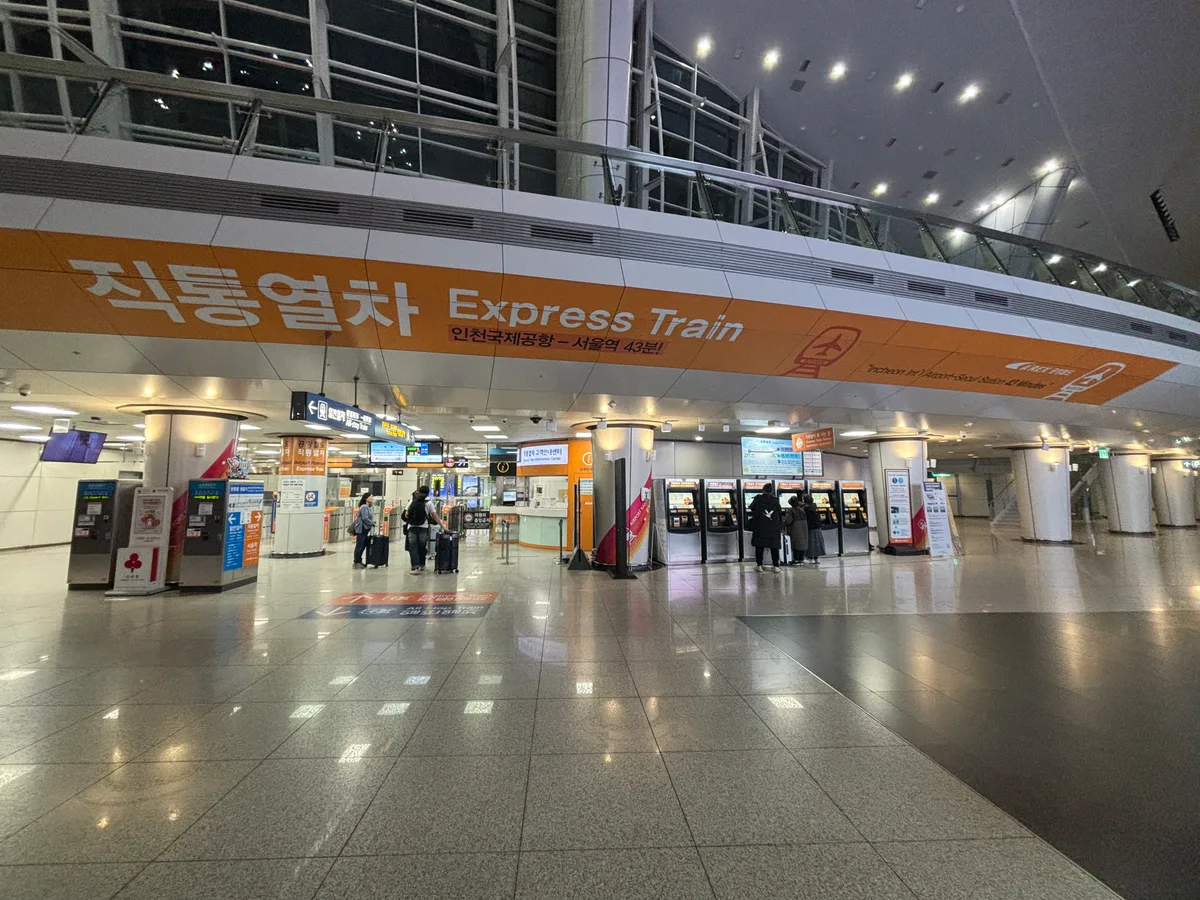
AREX's Express service connects Incheon and Seoul Station without intermediate stops, while the All Stop service serves stations including Gimpo Airport, Hongik University and Gongdeok. That distinction is more important than assuming the train with Express in its name always produces the shortest hotel journey. [3]
For a Hongdae stay, a service that reaches Hongik University directly may avoid backtracking from Seoul Station. For a KTX departure or a hotel near Seoul Station, the Express service may be the cleaner choice. Compare ticket conditions, terminal, walking distance and the connection at the city end.
Confirm whether the airline uses Terminal 1 or Terminal 2 for your flight. Use the terminal shown in the current airline or airport information, especially if the reservation was made months earlier. A transfer plan based on the wrong terminal can consume the margin you thought you had.
Airport buses or a booked vehicle may suit a hotel far from a useful rail stop. Check the actual stop and current service times rather than choosing from a neighborhood name alone. If the flight lands late, assess the timetable after allowing for arrival procedures and baggage collection.
Changing between Incheon and Gimpo
The AREX All Stop line links the two airports; the non-stop Express is not the airport-to-airport service. You still need to get from the arriving terminal to the station and from the destination station to the correct terminal. [3]
- Read both tickets and confirm ICN or GMP, the terminal and the local calendar date.
- Ask the airline whether baggage is through-checked and whether the connection is protected; do not infer this merely because the flights appear in one search result.
- Establish the arriving flight's immigration and baggage requirements and the next flight's check-in deadline.
- Plan the landside journey with the exact terminals and realistic waiting time.
- Keep a backup that remains workable if the first flight is delayed, including an overnight option when appropriate.
A road transfer does not remove the arrival and departure procedures. It replaces the rail segment with a road segment that can be affected by traffic. Choose it for practical reasons such as luggage or mobility needs, not as a way to rescue a connection that has no reasonable margin.
Separate tickets: count backward from check-in closure
Start with the second airline's deadline for your fare and airport. Work backward through check-in, terminal arrival, the ground journey, baggage collection and arrival formalities. Add room for a delay to the first flight. This produces a personal planning margin; it does not create an airline guarantee.
If that exercise leaves the connection unattractive, change the flights instead of reducing every allowance until the plan fits. A separate-ticket international departure after a Jeju flight deserves particular attention because disruption to the first ticket can affect a much more expensive onward journey.
Ask what the seller means by a connection guarantee if one is advertised. Read the process and exclusions before relying on it. A marketing label is less useful than knowing who provides assistance, what costs are covered and what you must do when disruption occurs.
Early departures and the final hotel night
Choose the final night's accommodation after checking the departure time. A central Seoul room may be perfectly suitable for a later flight; an early check-in can make an airport-area stay or prearranged transfer more practical. Include the extra move and meals in the comparison.
Do not assume an airport-area hotel's shuttle operates when your flight requires it. Confirm the first service, terminal served, reservation process and luggage arrangements. If the answer does not fit your check-in deadline, price the alternative transport before choosing the room.
Keep the final sightseeing day on the same side of the city as the luggage plan when possible. The less time you spend retrieving bags from a distant hotel, the more comfortably you can use the last afternoon.
A final airport checklist
- Both airport codes and terminal details match the tickets.
- Arrival and departure dates are understood in local time.
- The fare comparison includes checked bags and any ground transfer or overnight stay.
- The rail or bus service is running when you will actually be ready to use it.
- Airline check-in and baggage deadlines are saved, along with a contact route if the first flight changes.
- The hotel address and transfer instructions are available without relying on a live mobile connection.
Once these details are clear, the choice usually becomes straightforward. The better airport is the one that makes your particular route coherent, even if another airport appears closer to a generic city-center marker.
BEFORE YOU GO
Common questions
Does the AREX Express stop at Gimpo?
No. Use the All Stop service for Gimpo on the Airport Railroad route. Confirm the train type before buying a ticket or boarding. [3]
Is Gimpo always the better airport for Seoul?
No. Compare the available flights, fare, timing and hotel route. Its location can be convenient, but a poor flight schedule or an unnecessary connection can outweigh that advantage.
How much time should I leave for an airport change?
There is no universal guarantee. Use the airlines' actual deadlines, arrival requirements, exact terminals, ground journey and a delay allowance. An overnight can be preferable when a separate-ticket connection is otherwise fragile.
THE INFORMATION BEHIND THE GUIDE
References
Official and operator information checked on 9 October 2026. Recheck conditions for your own dates. The itinerary and decision examples are editorial suggestions; they are not booked services or first-hand reviews.
- Incheon–Jeju resumption: published May–August 2026 schedule ↗Korea Tourism Organization · checked 28 October 2026
- Gimpo Airport public transport and rail connections ↗Korea Airports Corporation · checked 9 October 2026
- Getting to Seoul: airport rail and ground transport ↗Seoul Tourism Organization · checked 9 October 2026